Scout and the Rescue Dogs classroom activities

August = CBCA Book Week Month. A busy and exciting time for children’s book authors and illustrators as they visit readers across Australia. I love seeing posts from librarians and shadow judges, especially this year, as their displays feature my own shortlisted title Scout and the Rescue Dogs. Scout is also shortlisted for WAYRBA and was this year’s winner of the WA Premier’s Book Award for Children.

At this busy time of the year, I have some fun extension suggestions for teachers and librarians, including a Forever Home Wanted activity to download. This can be adapted for all ages. If you enjoy the activity, please share it and send me a photo of your completed dog bios…

Book trailers are a great way to teach students about blurbs and summarising books. Your students might enjoy this Book Trailer, created by 12-year-old Eden Montgomery.

Children’s Book Week costume: to be Scout, all you need is a shirt with a truck or dog pattern, a cap with a possum, a bag of stones, or a big fluffy dog (real or stuffed 😉

Scout and the Rescue Dogs lends itself to mapping ideas. Try mapping Scout’s journey on a large map. Students could research individual towns, or map a new philanthropic dog food route for Scout, her dad, and Molly.

Philanthropy is a wonderful word and a great thing to celebrate. Ask students what kind of philanthropist they’d like to be? What are some ways they can help their community now? Research local volunteers and invite them to morning tea at school.
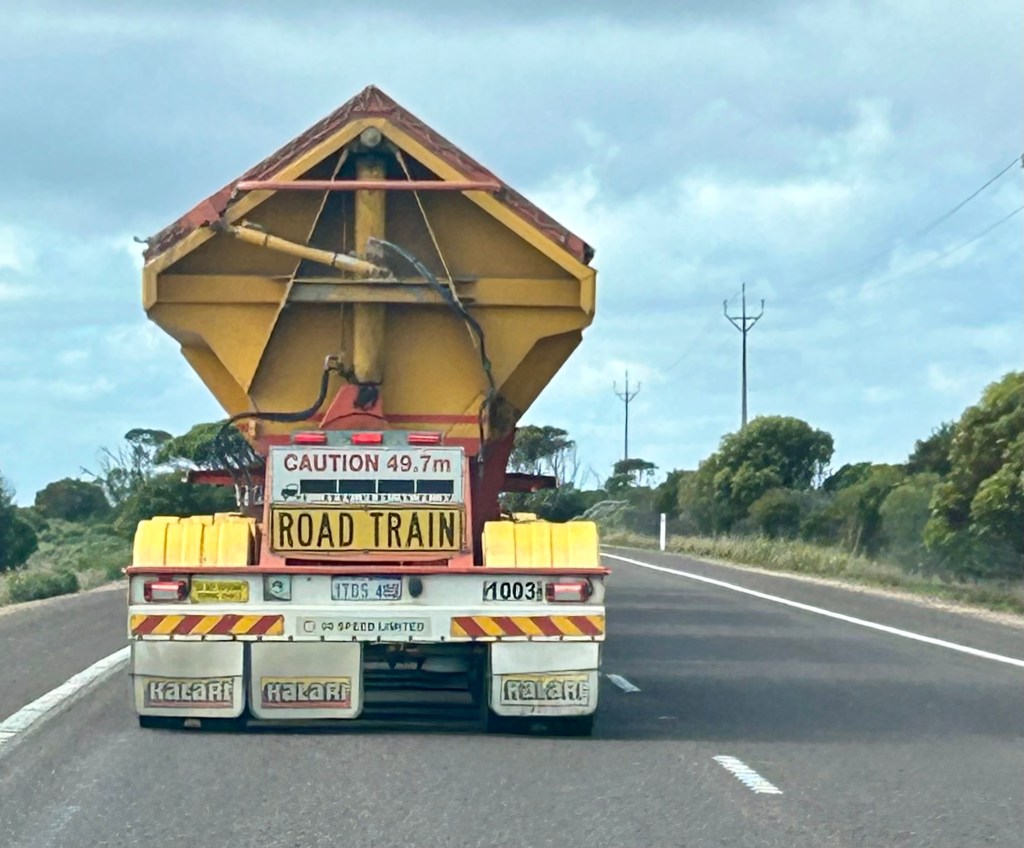
Are there truck lovers in your class? If so, it’s time to get your head around the differences between a triple, a b-double, a regular semi, and a giant like this 50-metre swimming pool sized truck. You need a big runup to pass this monster! Truck cabins are cosy, could your class reading nook become a truck cabin?

Do you remember the Black Summer fires? Write a journal entry, real or imagined from the POV of a fire-fighter, a wildlife carer, or someone whose home was impacted. Amidst the horror, kind people across the world tried to help. In pairs act out an interview scenario. Choose an Australian animal and research ways to care for it.

Owning a pet is a huge responsibility. Who has a dog? Would they make a good truck buddy? Does anyone have a different kind of pet that could be a truckie companion? Use bios from the book or your local dog/cat shelter as inspiration to make bios for them.

Teachers and librarians, do you have other Scout and the Rescue Dogs activities that have worked well with your students? I’ll be sharing more ideas over the next few weeks, and updating activities, so please send your ideas. And in the meantime, here is a link back to the Scout page for more info. Check out the gorgeous truck dog photos, the writing back story, and all the best for a wonderful Children’s Book Week!
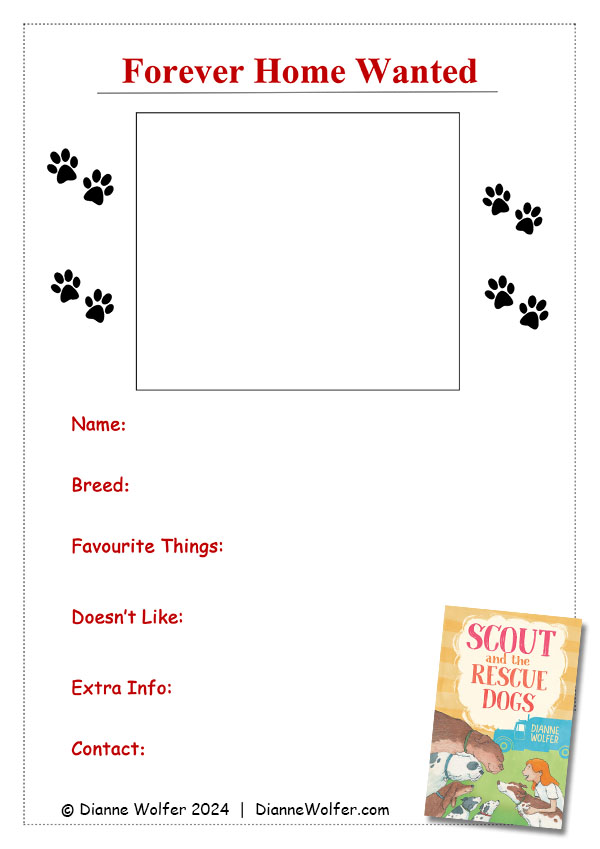
Download the activity (pdf)

AATE/ALEA National Conference (Perth)

Pre-conference events begin tomorrow and I’m super-excited to be joining educators from across Australia and the world to share conversations about the 2018 theme, the Art of English: Language, Literature, Literacy. My hands-on workshop tomorrow will focus on Creating Creative Writers: Teachers as writers, and we’ll see how much we can create in two and a half hours … Then my Monday keynote focuses on my favourite topic of all time, Anthropomorphism in Children’s Literature; bring on the sharks, octopi and dog characters!

Looking forward to meeting teachers, librarians and children’s book industry colleagues.


‘In the Lamplight’ – background #4 – Jimmy the wallaby mascot and a Harefield cockatoo

jj

Imagine being a wallaby in a small English village during WWI.  Jimmy (sometimes referred to as Jimony) was one of many Australian animals taken to WWI as mascots to cheer the troops and to remind them of home. Jimmy’s story is both strange and sad … Researching this wallaby was time-consuming. There were differing accounts surrounding Jimmy, making it hard to know which lead to follow. I also found historical inconsistencies when I was researching Lighthouse Girl and Light Horse Boy. It’s an exciting and frustrating part of writing historical fiction. As time goes by, more primary resources are uncovered, shedding new light on what we know and stories can change.

AWM image 4118702

Before Jimmy became the mascot of the No 1 Australian Auxiliary Hospital at Harefield, he was the mascot of the Australian Third Division. Tanya Britton’s Harefield during the First World War reports that, ‘Jimmy had been presented to one of the volunteer [hospital] workers in October 1916 by the daughter of Sir William Birdwood…’ Meanwhile Mary P. Shepherd’s Heart of Harefield reports that, ‘In October 1916, before setting out for France, men of the Third Division AIF presented a wallaby (a small kangaroo) to one of the volunteer workers, the daughter of General Sir William Birdwood …’ The difference between the two is slight but important; was Nancy Birdwood entrusted with Jimmy’s care or did she present him to someone? It’s an intriguing detail which is still on my list of things to discover.

Nancy’s story is also fascinating. She was the eldest daughter of General Birdwood, the man who commanded the Australian troops for much of the war. She volunteered at Harefield Hospital, fell in love with a Western Australian airman and ended up migrating home with him. But that’s another story …


Back to Jimmy. It seems that Harefield’s wallaby mascot regularly strayed from the hospital, roaming/hopping around the village, bringing smiles to the faces of patients, nurses and villagers. However this freedom also led to Jimmy’s untimely passing. Harefield’s beloved wallaby was remembered as, ‘the most peaceable and tame of any animal of that kind …’.

Reports surrounding Jimmy’s death varied greatly. To try and unearth the truth, I travelled to the Australian War Memorial Research Centre in Canberra and trawled through 100 year old copies of Harefield Park Boomerang, the hospital’s magazine. My patience was rewarded with the article extract on p.57. Rose’s diary account on p. 56 is based on this primary resource. This also cleared up any confusion regarding his name.

Jimmy wasn’t the only Australian mascot at Harefield. There was also a cockatoo which had been brought from the trenches of Gallipoli. The bird had the unnerving habit of imitating the sound of a Turkish shell blast. This wasn’t good for the shell-shock patients.

One of the things that fascinated me as I wrote Light Horse Boy was the variety of WWI mascots; there were dogs, cats, rabbits, monkeys, roosters, kangaroos, wallabies and even one poor koala named Teddy. They seemed to bring a smile to the faces of the soldiers. When I visited the Gallipoli Peninsula I was amazed to find similar WWI images in Turkish museums. The old photographs showed Turks playing with their small animal mascots in just the same ways. Soldiers have been taking animals to war since our earliest stories. Sadly for the Australian veterans, the animals were not allowed to return, but then again, there are the stories of warhorse Sandy and canine Horrie …

Thank you to the Department of Local Government, Sport and Cultural Industries for their generous funding support.

What’s your Daemon?

crow

As my research into anthropomorphism and animal stories continues, I came across this lovely snippet from The Guardian whilst pondering Philip Pullman and his powerful use of daemon in His Dark Materials trilogy. I love the characters in Pullman’s series, particularly Iorek Byrnison; my all-time favourite character (along with Reepicheep and Eeyore). The article features illustrators drawing their own imaginary soul animals.

While I like to think my daemon would be some kind of large, shaggy dog (sorry little Harry), or a wolf or whale-shark, I remember once dozing on a plane and having a very strong sense of a wise, black crow on my shoulder. Or perhaps it was a raven. Either way, the image stayed with me. It felt like it was important and needed to stay.

Having googled Crow, the Universe of Symbolism site says this animal,’opens us to the gifts of ancient wisdom and sacred law.’ That seems to fit the sense of letting the crow stay. Alternatively Raven is, ‘the black winged messenger from beyond’. That sounds rather interesting too …

In a paper entitled What Makes a Classic? Daemons and Dual Audience in Philip Pullmans His Dark Materials, Professor Susan R. Bobby writes that:

… in The Golden Compass, the seaman tells Lyra that she can’t choose her daemon’s form, that he will choose his own (167-68). This is akin to saying to a child that one cannot reject part of one’s nature: if one prefers serving others, one’s daemon will settle as a dog, but if one is deceptive and crafty, one’s daemon may settle as a serpent. Pullman has revealed we should ask our friends what forms our daemons would take, because our friends may be more honest about our true nature than we would be ourselves (“Philip Pullman in his” 4). In fact, children may be surprised to know that Pullman sees his own daemon as a jackdaw or magpie, since he explains ” ‘A magpie is a thief: it takes the things that belong to someone else, bright and shiny things–and makes them his own. And that’s what writers do, isn’t it? ‘ ” (Andronik 43).

Philip Pullman is a writer I greatly admire. I guess if he has a magpie, then maybe having a crow on my shoulder is not such a bad thing, even though I think I’d prefer to be followed about by a grey wolf…

Daemon are interesting things to consider. If you have one (imaginary daemon included), I’d love to hear what shape it takes. And if you haven’t read Pullman’s His Dark Materials, an amazing journey awaits you.