As Bookweek Month draws to a close, children’s authors and illustrators across Australia will be slowing down before heading back into their creative caves. I’ve had a wonderful Bookmonth travelling from Albany to Broome, from Perth to Sydney, from Canberra to the NSW Central Coast. Massive thanks to the dedicated teachers, librarians and Children’s Book Council of Australia volunteers who organised my visits. You are legends! I’ve met thousands of young readers and seeing that the joy of reading is alive and well enriches my work and inspires me.
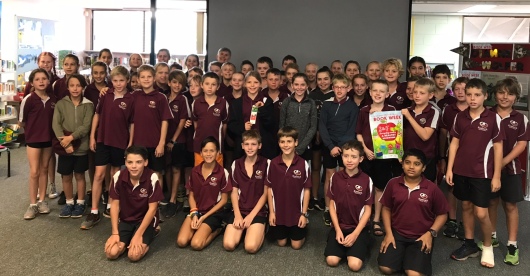
Students from Roebuck Primary
When you live in chilly Albany, being invited to celebrate Bookweek with Broome students, teachers and librarians in July is like winning a children’s author lottery. During a week of presentations, I spoke with hundreds of students from Years 3 to 10. Broome library staff made a great welcome display and young readers from St Mary’s College, Broome Primary and Roebuck Primary came into the library to ‘Find Story Treasure’ and celebrate the Bookweek theme.
Win a signed copy of Dianne Wolfer’s new book, The Dog with Seven Names.
Poor Harry doesn’t love dressing up, but maybe your dog does …
During WW2, the dog in Dianne’s new story is given seven names; Princess, Dog, Flynn (after the founder of the Flying Doctor Service), Gengi (gold), Florence (after the famous nurse), Pooch and Engel (angel).
Choose one of those names as inspiration to style your own dog and send Dianne a photo. The one Harry likes best will win a signed book (posted to you). Photos will be shared on Dianne’s Blog and/or Dianne Wolfer – Author Facebook page. https://www.facebook.com/DianneWolferAuthor/
Pre-conference events begin tomorrow and I’m super-excited to be joining educators from across Australia and the world to share conversations about the 2018 theme, the Art of English: Language, Literature, Literacy. My hands-on workshop tomorrow will focus on Creating Creative Writers: Teachers as writers, and we’ll see how much we can create in two and a half hours … Then my Monday keynote focuses on my favourite topic of all time, Anthropomorphism in Children’s Literature; bring on the sharks, octopi and dog characters!
Looking forward to meeting teachers, librarians and children’s book industry colleagues.
Now that I’ve caught my breath after returning from my whirlwind UK book launch and schools tour, I can at last share some of the lovely photos.
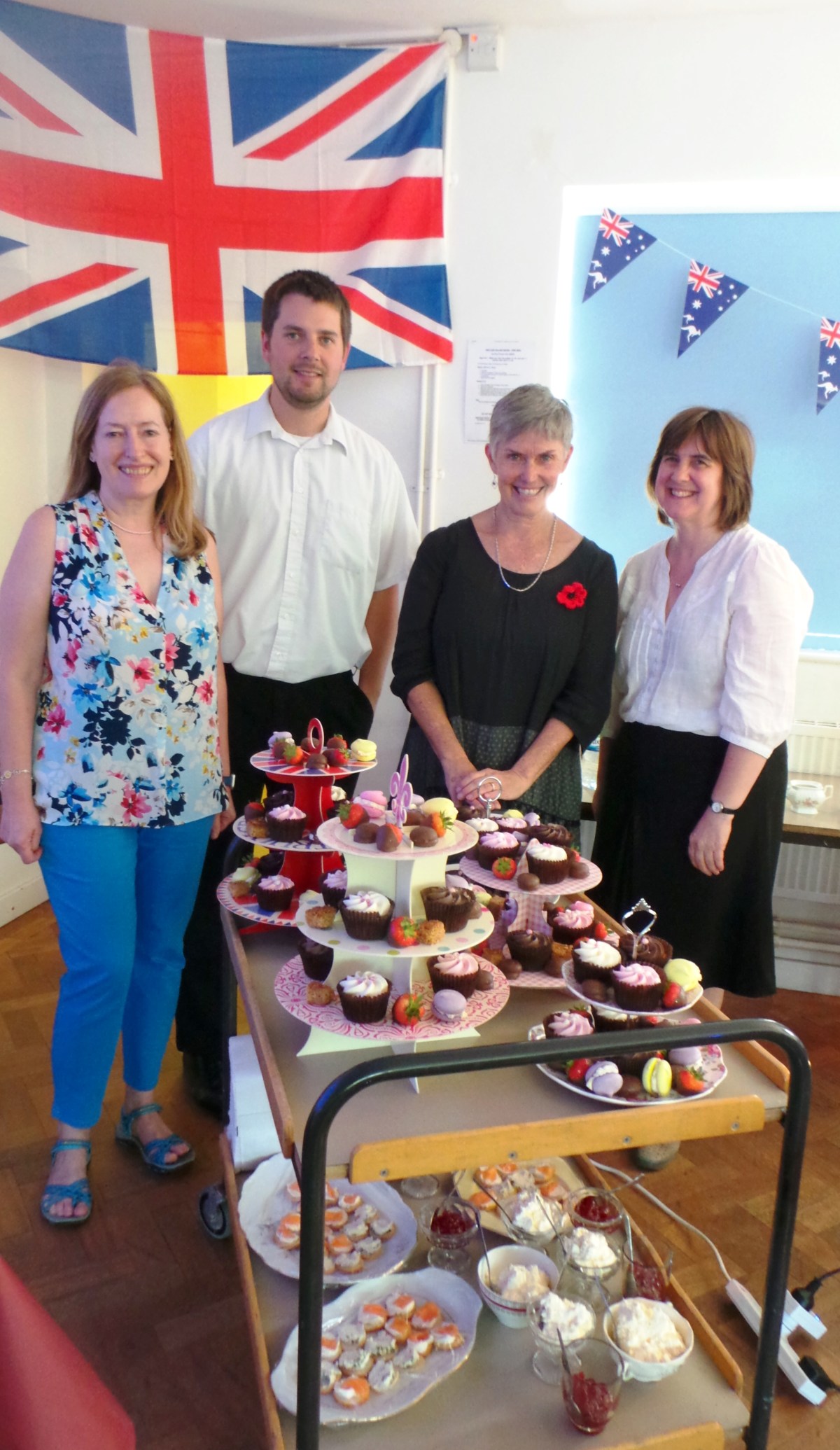
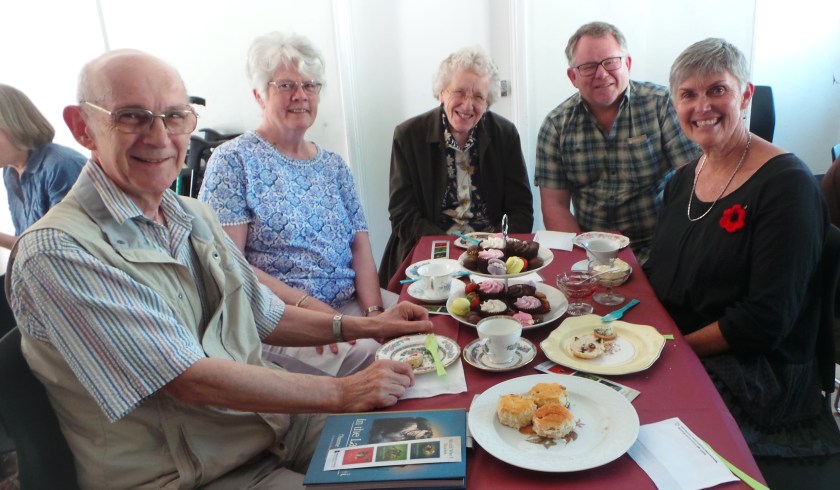
The Harefield Library and Harefield History Society both gave generous support, making the UK launch of In the Lamplight a friendly and memorable occasion. Library staff decorated their function room with Australian and British flags symbolising the close connection their town shares with Australia. Lara Marshall, Richard May and their team also provided a beautiful afternoon tea, complete with savouries, delicate cakes and delicious scones, jam and cream. Their kindness made me feel so welcome.
with Harefield library staffWith Harefield History Society members. Andy Harris (front left) gave valuable research help.
After a presentation showing pages from the book, with images from Harefield and evocative charcoal illustrations by Brian Simmonds, we shared stories about WWI, the village, now and then, and also the hospital. Then we enjoyed the scrumptious food. I learnt a lot more about the town’s history and made lovely new friends.
Despite the perfect spring sunshine outside, it was a wonderful turnout, made even more special by the arrival of family members, Brooke and Justin, who are working in Peterborough. Linda Evans my very first contact in Harefield also popped in for a chat, despite having another commitment. Thank you to everyone who helped make the celebration so special. I’d encourage any Australian history lovers who are visiting London to add a side trip to Harefield to visit the WWI Anzac cemetery and meet the friendly locals. I’m hoping to return and fingers crossed for another visit in 2019.
Thanks again, to the Department of Local Government, Sport and Cultural Industries for funding support which made this launch possible.
with suffragette Alice from St Vincents Altrincham
Alice and friends from St Vincents Altrincham
with from Kane from Harefield Junior School
students from St Vincents Altrincham
I’ve enjoyed a wonderful week of speaking and workshopping at schools across Hillingdon and Greater Manchester, celebrating the launch of In the Lamplight which is set in the UK during WWI. Students were keen to tell me about their favourite books and share personal stories. Some lovely readers like Karl from Harefield and suffragette Alice from Altrincham (pictured above) also love writing stories. And Karl wants to become an author 🙂 I was made welcome at all of the schools; thank you to staff at Harefield Infants School, Harefield Junior School, Harefield Academy, Hermitage Primary, Cedar Park School, St Vincent’s Knutsford, St Vincent’s Altrincham and Loreto Preparatory School.
There were so many highlights. I especially enjoyed talking about Australian/UK WWI links especially those relating to Harefield Hospital. Showing historic photographs that appear in the book was fun and speaking to hundreds of St Vincent’s Altrincham students dressed in costumes for History Day was amazing. Thank you to parent helpers Sharon Dobson and Catherine Collins (and Lucy, Molly and Erin) for introducing me to your fabulous schools. It’s all been wonderful …
And a special bouquet to my friend Clare Valley (originally from the UK) for sharing school/friend/family contacts. For fellow Australian authors planning a book tour, one of the most valuable things I’ve learnt from this experience is the importance of connections and word of mouth. UK schools are very security aware, without introductions from Clare I would not have been able to reach as many readers. Clare put hours of her own time into helping me plan and I am very grateful.
And thank you again, to the Department of Local Government, Sport and Cultural Industries for generous funding support.
There are many places I could have stayed in Harefield, indeed I originally booked somewhere other than Black Jack’s Mill, but something about the B&B on the canal called me. Imagine my surprise, when today I found out, that after donating their manor house for the use of convalescent soldiers in 1914, the Australian Billyard-Leake family moved into Black Jack’s Mill!
I love serendipity and have enjoyed sharing interesting conversations with other children’s authors about strange coincidences linked to their work. Synchronicity seems especially common to authors who write historical fiction (looking at you Mark Greenwood and Norm Jorgensen). To research In the Lamplight, I thought I’d read all the books about Harefield Hospital in WWI, but discovering this small snippet in Tanya Britton’s, The ANZAC Hospital No. 1 at Harefield and the Australians who died there and elsewhere but who are buried at Harefield 1914-1918 has made my day, and started me thinking about serendipity all over again. It’s also made me keen to find out more about both the Billyard-Leake’s and Black Jack. So far no one has been able to confirm whether the latter was a horse or a man. Hopefully more details to follow…
12th May, the anniversary of the birthday of Florence Nightingale, is now widely known as International Nurses Day – a time to honour and appreciate nurses. And a perfect time for me to post about the amazing Australian women who travelled across the world to nurse wounded soldiers in Harefield.
On this same day in 1915, four Australian Sisters joined Matron Ethel Gray to begin scrubbing the Harefield manor home donated by the Billyard-Leake family in readiness to receive wounded. Three days later they’d polished floors, acquired linen, organised supplies and dragged mattresses into place. By Sunday 16th May, 80 beds were ready. Two weeks later eight patients arrived. A month later there were 170 patients. Numbers continued to rise and during the war years, around 50,000 soldiers were treated at Harefield House.
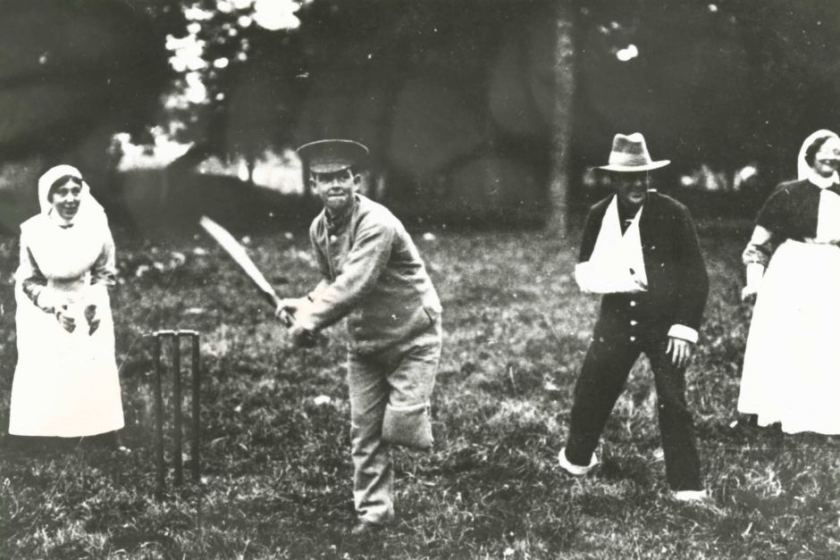
As well as nursing, the women tried to boost the men’s spirits by organising concerts, wheelchair races and cricket matches. One of the nurses, Sister Ruby Dickinson died during her service. She was buried with full military honours at Harefield’s Anzac cemetery. In the Lamplight is the final title in my ‘Light’ series and in this book I’ve focused on the changing roles of women during WWI. The story follows Rose, whose life is changed forever when WWI arrives in her peaceful village. While the suffragettes have put aside their goals for the duration of the war, Rose finds inspiration in the courage and dedication of the cheerful Australian girls, so far from home. She summons her own courage, firstly to read to the patients, and then to begin the challenging journey of becoming a nurse.
Thank you to the Department of Local Government, Sport and Cultural Industries for generous funding support.
Alfred Kemp, playing cricket with nurses at Harefield, Photo: Andy Harris
Karratha has an amazing new library and arts space, the Red Earth Arts Precinct and last night The Lighthouse Girl was their first theatre performance. Thank you to the City of Karratha Library (and a special shout out to Helena Mead) for organising my travel, so that I could attend and present a pre-show talk.
I left Albany at dawn, two flights and 2000km later I hit the ground running doing a presentation with the lovely Year 4 students at St Paul’s Primary , a quick shower and catch-up with Denmark Bookgroup buddy, Helen and then it was off to the new library for my pre-show PowerPoint talk about Lighthouse Girl, Light Horse Boy and In the Lamplight. The library is a stunning, light-filled space and the arts building is an impressive landmark. After my talk there was time for 15 minutes speed-signing then it was show-time.
with Helena Mead
with Giuseppe Rotondel, Nicola Forrest and Natalie Jenkins
This is the fourth time I’ve watched Hellie Turner’s beautful adaptation of my books and each time I notice new details. I’m fascinated by the way different audiences engage differently. There was laughter and tears. It felt very strange to feel that my work sparked this evocative production. At the end of the show I was touched to be called onto the stage by Benj D’Addario to share a curtain call bow with the cast. The theatre looked very different from up there…
After a few hours sleep, Helena collected me for an ABC breakfast radio interview with Ewan Gilbert and then another phone interview with Alicia from Pilbara Times and then it was back to the airport. What a fabulous whirl.
Thank you City of Karratha, Black Swan Theatre, Rio Tinto, ABC, St Paul’s Primary, Pilbara Times and everyone else who made my 24 ours in the Pilbara so special.
Imagine being a wallaby in a small English village during WWI. Jimmy (sometimes referred to as Jimony) was one of many Australian animals taken to WWI as mascots to cheer the troops and to remind them of home. Jimmy’s story is both strange and sad … Researching this wallaby was time-consuming. There were differing accounts surrounding Jimmy, making it hard to know which lead to follow. I also found historical inconsistencies when I was researching Lighthouse Girl and Light Horse Boy. It’s an exciting and frustrating part of writing historical fiction. As time goes by, more primary resources are uncovered, shedding new light on what we know and stories can change.
Before Jimmy became the mascot of the No 1 Australian Auxiliary Hospital at Harefield, he was the mascot of the Australian Third Division. Tanya Britton’s Harefield during the First World War reports that, ‘Jimmy had been presented to one of the volunteer [hospital] workers in October 1916 by the daughter of Sir William Birdwood…’ Meanwhile Mary P. Shepherd’s Heart of Harefield reports that, ‘In October 1916, before setting out forFrance, men of the Third Division AIF presented a wallaby (a small kangaroo) to one of the volunteer workers, the daughter of General Sir William Birdwood …’ The difference between the two is slight but important; was Nancy Birdwood entrusted with Jimmy’s care or did she present him to someone? It’s an intriguing detail which is still on my list of things to discover.
Nancy’s story is also fascinating. She was the eldest daughter of General Birdwood, the man who commanded the Australian troops for much of the war. She volunteered at Harefield Hospital, fell in love with a Western Australian airman and ended up migrating home with him. But that’s another story …
Back to Jimmy. It seems that Harefield’s wallaby mascot regularly strayed from the hospital, roaming/hopping around the village, bringing smiles to the faces of patients, nurses and villagers. However this freedom also led to Jimmy’s untimely passing. Harefield’s beloved wallaby was remembered as, ‘the most peaceable and tame of any animal of that kind …’.
Reports surrounding Jimmy’s death varied greatly. To try and unearth the truth, I travelled to the Australian War Memorial Research Centre in Canberra and trawled through 100 year old copies of Harefield Park Boomerang, the hospital’s magazine. My patience was rewarded with the article extract on p.57. Rose’s diary account on p. 56 is based on this primary resource. This also cleared up any confusion regarding his name.
Australian War Memorial image
taken at Harefield Hospital
Jimmy wasn’t the only Australian mascot at Harefield. There was also a cockatoo which had been brought from the trenches of Gallipoli. The bird had the unnerving habit of imitating the sound of a Turkish shell blast. This wasn’t good for the shell-shock patients.
One of the things that fascinated me as I wrote Light Horse Boywas the variety of WWI mascots; there were dogs, cats, rabbits, monkeys, roosters, kangaroos, wallabies and even one poor koala named Teddy. They seemed to bring a smile to the faces of the soldiers. When I visited the Gallipoli Peninsula I was amazed to find similar WWI images in Turkish museums. The old photographs showed Turks playing with their small animal mascots in just the same ways. Soldiers have been taking animals to war since our earliest stories. Sadly for the Australian veterans, the animals were not allowed to return, but then again, there are the stories of warhorse Sandy and canine Horrie …
Thank you to the Department of Local Government, Sport and Cultural Industries for their generous funding support.
So many stories came to light during three years+ of research. Each one worthy of its own book. The Anzac Flag and Harefield Quilt are two objects that captured the patriotic mood of the time. Both keepsakes survive one hundred years later; one in Harefield and the other in South Australia.
The Anzac Flag: Last week, I wrote about Headmaster Jeffrey running into a classroom to pull down a Union Jack to drape over Private Wake’s bare coffin. As the war continued more patients died and the flag was used many times to cover soldiers’ caskets on their final journeys from hospital to graveyard.
Photo: Andy Harris & Harefield History Society
Patients’ funeral cortèges passed down Harefield’s main street with villagers, patients and nurses in attendance. After the war ended, the Union Jack which had covered soldiers’ coffins was presented to the hospital’s last commanding officer. Lieutenant Colonel Yeatman was tasked with giving the flag to an Australian school and asking them to send their own flag in return. Adelaide High School was selected in recognition of the generous relief parcels which students sent to Harefield during the war years. Adelaide High School has treasured the Harefield Flag for over one hundred years, hanging it in a prominent position until it became too fragile to display. The flag has recently undergone extensive restorative work to preserve this symbol of friendship between communities.
The Harefield Quilt: was created in 1917 as a fund-raising exercise. It was made by volunteers of the British Red Cross Society. The idea with fund-raising quilts was that you donate a sixpence, write your name on a large cloth, ready to be embroidered. In the case of the Harefield Quilt, twenty small squares containing signatures surround a central square. The central patch shows the Red Cross emblem, the Advance Australia ensign as well as motifs of the 29th Battalion and 31st Battalion of the Eighth Brigade.
Photo: Andy Harris/Harefield History Society
Descendants of Mrs Helena Gough who opened tearooms in her home in High Street presented the quilt to St Mary’s Church for safekeeping in 1972. Each April the quilt is displayed on Anzac Day in remembrance of the soldiers who died in Harefield. In 2015 a centenary quilt was commissioned. It hangs in the Harefield Hospital.
Next Wednesday’s post will focus on Jimmy the wallaby mascot and the Harefield cockatoo. Thank you to the Department of Local Government, Sport and Cultural Industries for funding support.
After years of researching and writing, it’s interesting to look back at how a book started. The idea for In the Lamplight began with research for its partner titles, Lighthouse Girl and Light Horse Boy. Then around 2012, I heard about the Gilgandra Coo-ee March. After heavy losses at Gallipoli, WWI recruiting drives occurred across Australia (Men from Snowy River, March of the Dungarees). Gilgandra was the first.
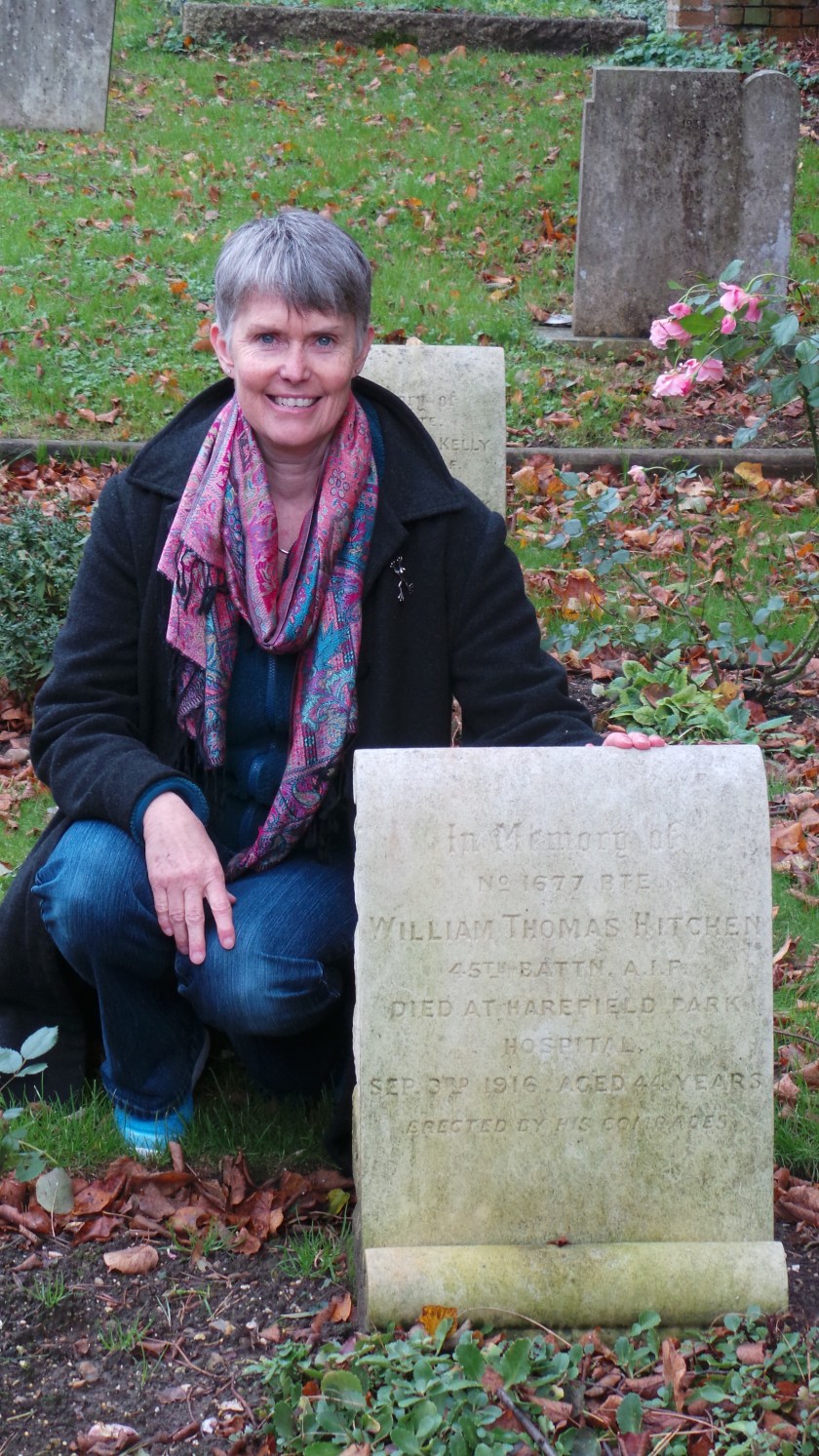
In October 1915 two brothers gathered a group of 26 men. They set out from Gilgandra on a march to Sydney (320 miles). By the time they arrived, the number of recruits had grown to 263. One of the brothers, Bill Hitchen (plumber and captain of the Gilgandra rifle club), died at Harefield in September 1916. Bill’s story inspired me and I was curious to learn more.
Fast forward to 2013 when I accompanied my husband on a trip to Albany’s sister city, Pèronne for Remembrance Day. Before flying home we had a day in London. While Pete walked around Westminster, I caught a train and bus to Harefield village, on the outskirts of London to visit Bill’s grave. A kind local helped me with directions. We began chatting and she walked with me to St Mary’s Anzac Cemetery, the resting place of Bill, 111 of his fellow soldiers and Sister Ruby Dickinson. I found Bill’s grave and then visited the Anzac Wing of Harefield Hospital, learning how in 1914 the Billyard-Leake family (expat Australians) donated their home, Harefield House for recuperating Australian soldiers to use for the duration of the war.
at the grave of Bill Hitchens (Gilgandra Cooee
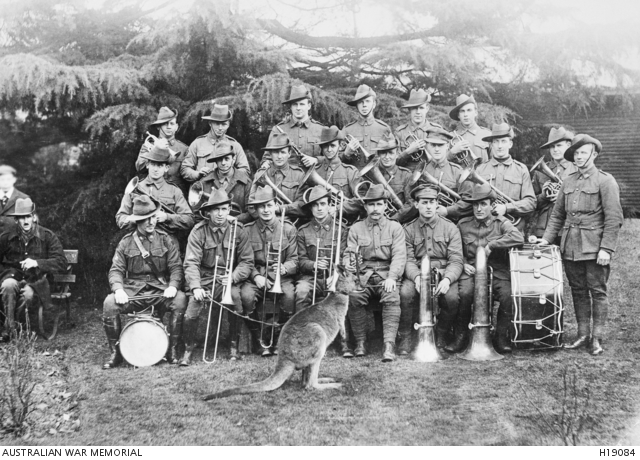
The Anzac wing also held photographs; evocative WWI images of recuperating patients and nurses. One photo captured my attention. It was a photograph of a nurse stroking a wallaby mascot. I’ve since found another AWM image of the wallaby, ‘Jimmy’ (sometimes named Jimony) being fed by the same nurse, who I discovered is Nancy Birdwood, daughter of General Birdwood (commander of the Australian Imperial troops). Nancy volunteered at Harefield Hospital and later married a West Australian airmen, but that’s another story…
Some readers know my fascination with WWI animal mascots. This began during the creation of Light Horse Boy and has continued to grow. I suspected that Nancy’s wallaby could be the same fellow that stands proudly to attention in the AWM photograph below (I love this photo). I wanted to find out more about the wallaby’s story and will post more about Jimmy in a future blog.
Australian War Memorial image
taken at Harefield Hospital
Australian War Memorial
Harefield House became the 1st Australian Auxiliary Hospital, sometimes treating up to 1000 patients. The first nurses, led by the very capable Matron Ethel Gray, arrived in May 1915. As casualties increased, life in the small village of Harefield changed forever. The village green was filled with homesick soldiers in their distinctive slouch hats. Kind-hearted villagers did all they could to help the young men so far from home. They read to patients, taught them handicrafts and French, took the men for automobile outings and organised concerts and sporting matches.
Deciding which WWI images to include in my book was a challenge. There were so many great photos. My favourites include patients skating around the frozen lake with the support of chairs, Jimmy posing with the brass band, as well as one moving photograph of a one-legged lad playing cricket with laughing nurses fielding. The lad looks so young.
More sombre photographs are also included; of funeral parades and shell-shocked amputees. During WWI over 50,000 Australian soldiers were treated at Harefield Hospital. Towards the end of the war, when Spanish Influenza ravaged Europe, there were deaths most weeks. Strong lads who’d survived months in the trenches, sometimes died within a day from this terrible illness as their lungs filled with fluid.
Harefield villagers lined the streets to honour funeral parades from the hospital to St Mary’s cemetery. The first death was in February 1916. As Private Robert Wake’s coffin passed the Junior School, headmaster Jeffrey ran inside, pulled a flag from the classroom wall and draped it over the bare coffin. This flag was used in subsequent funeral processions and still exists today (more on that next week). Connections between Harefield and Australia remain strong and I’m grateful to Harefield residents for their historical advice; particularly Lorraine Piercy and Andy Harris. Each Anzac Day, local schoolchildren lay flowers against the headstones for the Australians who died in their village.
Lest we forget.
Next week I’ll share two stories linked to In the Lamplight; the Anzac quilt and the Harefield flag. I am grateful for funding support from the Department of Local Government, Sport and Cultural Industries.
With less than a month until publication I’m now on countdown to the launch of In the Lamplightthe third and final book in my ‘Light’ series. From today, I’ll be writing a weekly blog post sharing details about my research and writing journey, but first, I’d like to acknowledge the generous support of the Department of Local Government, Sport and Cultural Industries. I’m the very grateful recipient of a Commercial Development funding grant which will allow me time to maximise interest in this new title and also help me try and gain a footprint in the elusive and hard to crack UK market. Wish me well and I hope you’ll follow my blog journey over the next weeks.
I’ll be writing about In the Lamplight‘s links to WWI Harefield (UK) and the 1st Australian Auxiliary Hospital that grew out of an expat Australian’s English manor house. We’ll meet Jimmy the wonderful wallaby mascot that hopped around Harefield village and some of the soldiers and nurses that served in Harefield during the war. I’ll share the history of the Anzac flag and its links to Adelaide High School. I’m also keen to post photos and information I discovered as part of my research about the suffragette movement, WWI nursing and changing roles of women, as well as after effects of the war and the horrors of the 1918/1919 worldwide Spanish Influenza pandemic (more deaths were attributed to influenza than entire war casualties).
illustration: Brian Simmonds
Next week my blog focus will be on Harefield, the English village just north of London (and setting of In the Lamplight), its WWI cemetery and ongoing Anzac links…
Heather Potter, the talented illustrator of Nanna’s Button Tin has kindly given me A3 photocopies of around twenty pages from her sketch pads to share with students during school visits. These pages are now laminated so that children will be able to examine samples of character development as well as see some of the magic behind cover design and page design.
I love seeing illustrator’s character sketches. In the published book Nanna wears the same white shirt and pink vest that she does in the top left image, however her pants changed to a slightly different floral design in the final.
The sketches on the right give some insight into how much work goes into every page, in this case, the scene where Nanna first met Pop. I love the pigeon on Pop’s head.
Heather also created a recurring page design that links to sewing and buttons. On four pages she used a thread line to split the right hand side page into two. The above sketches show some of the ideas she was exploring – the dog licking image is almost the same as a final image in the book.
Thank you Heather. Working with illustrators, watching them bring characters and ideas to life is one of the joys of being a children’s author.
For me celebrating the Year of the Earth Dog is timely as I have been hunkered down this week, completing a final (I hope) edit of The Dog with Seven Names. It’s a young YA novel set in the Pilbara during 1942 told from the POV of a dog. Yes, I can’t seem to get enough anthropomorphism!
While I’m a boring old buffalo, those lucky people born in dog years are honest and loyal with a strong sense of duty, just like my main character; Flynn/Princess/Gengi + 4 other names.
The research for this book has been fascinating and I’ve learnt so many things about WW2 Australian history. My dog character is a terrier cross, smaller than Harry (pictured above) and writing a story using dog senses has been both fun and challenging.
The Dog with Seven Names will be published by Penguin Random House in August 2018 (assuming I finish this draft!) and I’ll post more news and a sneak peek of the gorgeous cover in a few months. In the meantime, may your Earth Dog celebrations be joyous.
Last week (on Dianne Wolfer – Author) I posted a photo of my first batch of summer reads. I’m making good progress and have already finished Kate Constable’s New Guinea Moonwhich I very much enjoyed. The story has satisfying and unexpected twists. It’s marketed at a YA audience but like so many teen novels is just as enjoyable for adults. I’m drawn to books with PNG settings; three of my own works unfold there (The Shark Calleris set in the New Ireland Province and Photographs in the Mudis set along the Kokoda Track in 1942). The backdrop for New Guinea Moon is in the Highlands, pre-independence, a time when things are changing for both Nationals and expat Australians. Kate grew up in PNG and her use of local language and culture rings true.
My next read was fun. I have several ideas bubbling for emerging readers and so have been reading titles from the hugely successful I Can Read! series. Think Berenstain Bears, Fancy Nancy and Flat Stanley. Danny and the Dinosaur – Too Tall is a great example of a concise book with exciting characters and a compelling, exciting plot. How on earth does Syd Hoff weave this magic in 32 pages? Stories with depth that appear ‘simple’ are hard to create – editing, shaping, editing …
Michael Morpungo’s books make me cry. They are so good. I love animal characters and Morpungo is a Master of creating stories with powerful links between animals and humans and thought-provoking moments in history. After re-reading his poignant and lovely I Believe in Unicorns, I’ve been visiting Michael Morpungo’s website. I knew he was a prolific writer and I loved Shadow (set in Afghanistan), but there are so many others that look enticing. Perhaps I’ll spend summer reading all his animal novels… I’ve also just noticed that this month he’s releasing Lucky Button. After the synchronicity of the War Horse movie being released just before the launch of Light Horse Boy, I’m glad my Nanna’s Button Tin came out in June.
I’ll be posting more Summer reading blogs over the next few months. My Want-to-Read book tower is tall but I always love hearing recommendations …
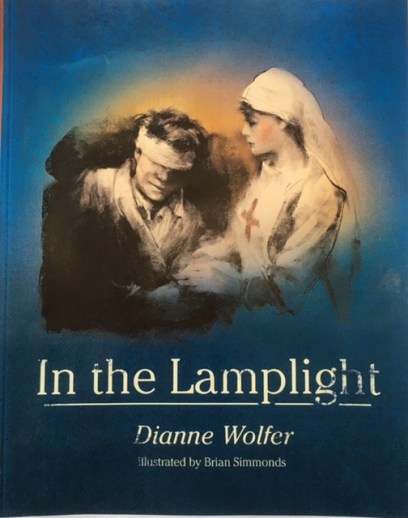
With Remembrance Day this Saturday and the final draft of my new manuscript going to print, it feels timely to share a sneak peek of the cover of this third title in my ‘Light’ series.
In the Lamplight is a companion novel for my historical titles Lighthouse Girl and Light HorseBoy. The story follows fictitious Rose through WWI and overlaps with Jim’s Light Horse journey, then links back to Albany’s King George Sound. Thank you to the Department of Local Government, Sport and Cultural Industries, whose generous support allowed me time to write a first draft. Here is the blurb:
Rose O’Reilly’s sheltered life in the peaceful English village of Harefield takes an unexpected turn with the outbreak of war in 1914. A local manor house becomes a repatriation hospital for wounded Australian soldiers and Rose begins helping out by reading to patients and pushing wheelchairs.
As the war progresses, and slouch hats fill the village green, Rose’s skills grow and she begins training alongside the Australian nurses. Then a new patient arrives. Sergeant Jim O’Donnell is unable to walk and his eyes are bandaged, but he will change Rose’s life forever.
In the Lamplight will be published by Fremantle Press in April 2018. I’m currently taking (WA) bookings for school/library visits in the last two weeks of Term 1. Please email me (contact tab) if your school would like an Anzac themed presentation (ASA rates and small travel fee). I’ll also be visiting schools in the eastern states, probably early Term 2. I’ll post again with more details and launch information early in 2018.
Last week I had the pleasure of working with Year 6 students from across Perth as part of The Literature Centre’s Talented Young Writers’ program.
We crammed a range of springboard writing activities into one day and I was impressed by the students’ creativity and eagerness to try new ideas and share first drafts. The Talented Young Writers’ Programme is unique. Its aim being to nurture a group of students over several years. Young writers (in Perth and regional centres) work with four writers each year. The educational benefits are multi-faceted and assuming ongoing funding can be found, the future of story-telling in WA is in excellent hands.
My sessions came hot on the heels of The Centre’s 2017 Celebrate Reading Conference so last weekend I was fortunate to attend the second day and hear inspirational sessions by Gus Gordon, Meg McKinlay, Kyle Hughes-Odgers, Deb Abela, Mark Wilson, Anna Fienberg, Jeannie Baker and Australian Children’s Laureate Leigh Hobbs.
Thank you Lesley Reece, Beck Blaxell and everyone at The Literature Centre for a wonderful week. I’ve come home tired but brimful of ideas and inspiration! If anyone is able to support The Centre by becoming a Friend, just click on this link.
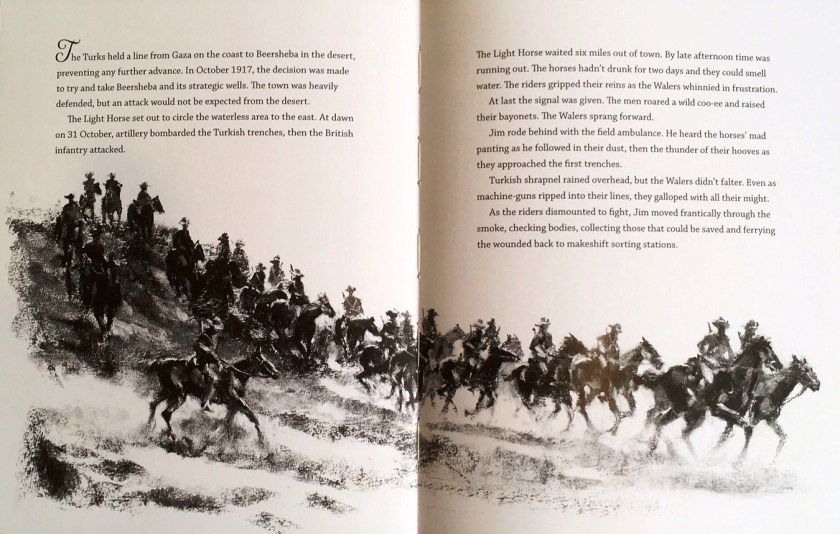
With the 100 year commemoration of Beersheba it feels timely to share some background to my historical story, Light Horse Boy. I was recently invited to contribute text to the Westbury RSL Light Horse Remembrance. Here is part of that tribute:
Light Horse Boy was sparked by research for its companion title, Lighthouse Girl.
As I read about the thousands of Walers taken to WWI battlefields and the bonds between the horses and Australian soldiers, I knew I needed to write a second book. My writing journey spanned three years. I became fascinated by the story of Sandy. For me he represented all the Walers; those faithful and brave horses that didn’t come home. As I learnt more about Sandy, the shape of my manuscript changed. I found a reason to shift my fictitious human character, Jim from the troopship Wiltshire to the flagship Orvieto, by making him a farrier, thus allowing Jim to meet Major General Bridges and Sandy, and for their stories to interweave. After four years of battle I then wanted to find a way for Jim and Sandy to reunite, so that I could introduce young readers to Sandy’s story.
I live in Albany, the place where troopships of the 1st and 2nd AIF convoys gathered in late 1914, now home to the National Anzac Centre and the iconic Desert Mounted Corps Memorial, a recast of the original horse and soldier statue erected at Suez in 1932. Each Anzac Day a Dawn Service is held beside this powerful memorial. I’ve often gazed at the evocative statue imagining the stories of Light Horse men and their mounts.
My Light Horse Boy research took me to the Gallipoli Peninsula, Major General Bridges’ grave in Canberra, Maribyrnong, home of the remount centre where Sandy spent his post-war years and the AWM Research Centre. Along the way I learnt the names of faraway battlefields; El Arish, Magdhaba, Romani, Gaza and of course Beersheba.
Crafting an historical novel, for me, involves months of research, then I write (well over a hundred drafts) until a solid read-through version emerges. Then the hard work begins; shaping and editing, trying to cull anything that doesn’t add to the story arc. The final draft is like the tip of an iceberg. Readers will be unaware of the shaping and substance below, but that weighty base is important. The Beersheba scene in my story typifies this. For the spread above, I read several military titles, trying first to fully understand nuances of this extraordinary charge and then to capture the heart of this battle in an engaging way for young readers. Most of all I wanted to ‘get it right’ as a way to honour those who served – both human and animal.
For a year or so, I’ve been struggling with finding the right title for my almost completed manuscript, a companion title for Lighthouse Girl and Light Horse Boy. For continuity reasons I wanted the word ‘light’ somewhere in the title. We aren’t meant to judge a book by it’s cover, but research indicates that many of us do.
This story has been on the back-burner since 2011 when I visited the Anzac cemetery in the UK village of Harefield to research another idea (more about that journey in future posts). Ideas bubbled away as I completed other projects and then last year, at last, I was able to give this story dedicated time (thank you Department of Local Government, Sport and Cultural Industries). While the manuscript was a work-in-progress I initially referred to it as Quarantine Rose; a shocker of a title which I knew would never be the one. I couldn’t change my central character’s name because Rose is an overlap character with Light Horse Boy. For a while the title shifted to Rose on No Man’s Land, linking the story to a popular WWI song. However Rose works in a hospital not on the battlefield.
As the manuscript took shape I knew I needed a better title. At the annual SCBWI Rottnest retreat, fellow author Norman Jorgensen came up with the evocative Light from a Broken Lantern, however as the story progressed, there was more hope than brokenness. Sorry Norm!
Sometimes the right title appears at the same time as the first story idea. Other titles involve weeks of compiling lists and thesaurus trawling. Lighthouse Girl for a long while was Postcards from Breaksea, or simply Postcards. Then about two years into the four year writing process, the current tile settled. For Light Horse Boy, the final title was always the one.
With my going-to-print deadline quickly approaching, this month I sent out a cry for help. Thank you friends and family, writer group peers, bookgroupies and others who answered my call. You offered so many great suggestions. Even the cheeky suggestions from family were useful, as they sparked other ideas using the words light, shadow and darkness.
Meanwhile Fremantle Press have been market-testing one of the options on our short-list of title choices and I am pleased to finally announce that the title has been decided. The book will be called In the Lamplight. Tentative release date is April 2018. I hope readers will enjoy this new addition to the ‘light’ series. Thanks again to all the wonderful title-hunters for your kind suggestions…
I’m fortunate to be celebrating the occasion on a Pacific island, taking a week’s break before August; a month of Festival/Library/School visits and Bookshop events (more details next post).
Snorkelling here everyday reminds me how observing the busy minutiae of life on a coral reef inspired my novel The Shark Caller. So much is happening on even the smallest reef. Tiny fish, bright coloured, striped, spotted and plain, dart under rocks, hide in anemone or between coral scaffolding, while larger fish chase them or snuffle through sand or chew coral. Meanwhile the slower sea slugs and starfish make interesting patterns in the sand.
The island we are visiting is a sanctuary for turtles and sea snakes. Swimming with the former is a bucket-list delight. I’m trying to get used to the latter. Overcoming fear of strange creatures is something Izzy needed to do in Shark Caller to complete her quest. Like Izzy, I often find that adventure involves duality, it’s one of the themes that interested me during the long writing process of this book. The Shark Caller plot explores twin bonds and aspects of our shadow sides. It’s about light/darkness as well seeing degrees of ‘good’ and ‘evil’ within characters (and ourselves). And as I snorkel, I still wonder why creatures like octopus and sea snakes spook me whilst I seek out other (also strange) creatures like turtles.
The lagoon here seems too shallow for sharks (certainly no mako…), however yesterday I did see another creature from the story. From the vantage point of the jetty at low tide, I watched three different octopus, none as scary as Pyrena thank goodness although one was largish… I find octopus exquisitely creepy as they writhe across the sea floor uncurling their arms then suddenly jetting away when they’re disturbed. They’re intelligent and noble in their own weird way, but I prefer to have space between us.
Swimming above gaps under rocky overhangs reminds me of another aspect of the story, imagined passages to ocean vents and otherworldly creatures. I don’t think this lagoon hides underwater tunnels, but I guess you never know!
When I began writing this blog I found a long ago shark post which I forgot to publish. I drafted it soon after the release of The Shark Caller, as the first reviews began to arrive – always an exciting moment when they’re positive. I smiled when I read the opening line of the very first review by Joy Lawn in Books +Publishing:
The Shark Caller breaks new ground in junior YA fiction.
And was honoured to receive the following praise from living legend Hazel Edwards OAM (author of the famed Hippo on Roof books) in Goodreads:
This is the best book for the 10-12 ish age group that I have read this year. Highly commended for adults too. And it’s a pleasure to savour the language.
Author Heather Waugh‘s comment was rather octopus-like: ‘it lured me in and held me. It’s been a while since I’ve read magic realism, and I sank back into it like a comfy couch.’
But my favourite review came from primary student Lila, who says:
Dad, Mum and I have just finished your book Shark Caller and we all loved it. Mum and Dad loved it so much they had to read it after I went to bed, and Dad couldn’t put it down so he accidentally stayed up ’til 1:30am reading it! My favourite part was reaching Sephone after escaping Pyrena and onwards. For me the most tense part was in the Cavern with Pyrena and escaping her. I also loved the words especially solwara, puripuri and tumbuna.
Happy Shark Week everyone, may you also find clear waters in which to celebrate with some friendly marine creatures.






 There are many places I could have stayed in Harefield, indeed I originally booked somewhere other than Black Jack’s Mill, but something about the B&B on the canal called me. Imagine my surprise, when today I found out, that after donating their manor house for the use of convalescent soldiers in 1914, the Australian Billyard-Leake family moved into Black Jack’s Mill!





 I’m the very grateful recipient of a Commercial Development funding grant which will allow me time to maximise interest in this new title and also help me try and gain a footprint in the elusive and hard to crack UK market. Wish me well and I hope you’ll follow my blog journey over the next weeks.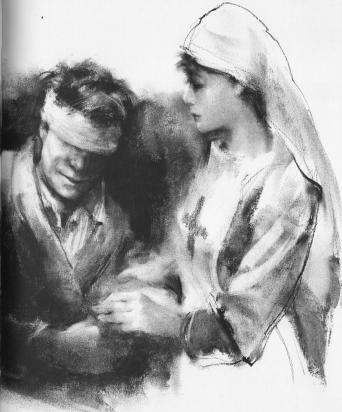



 If it’s a book title, a lot!


 Dianne Wolfer